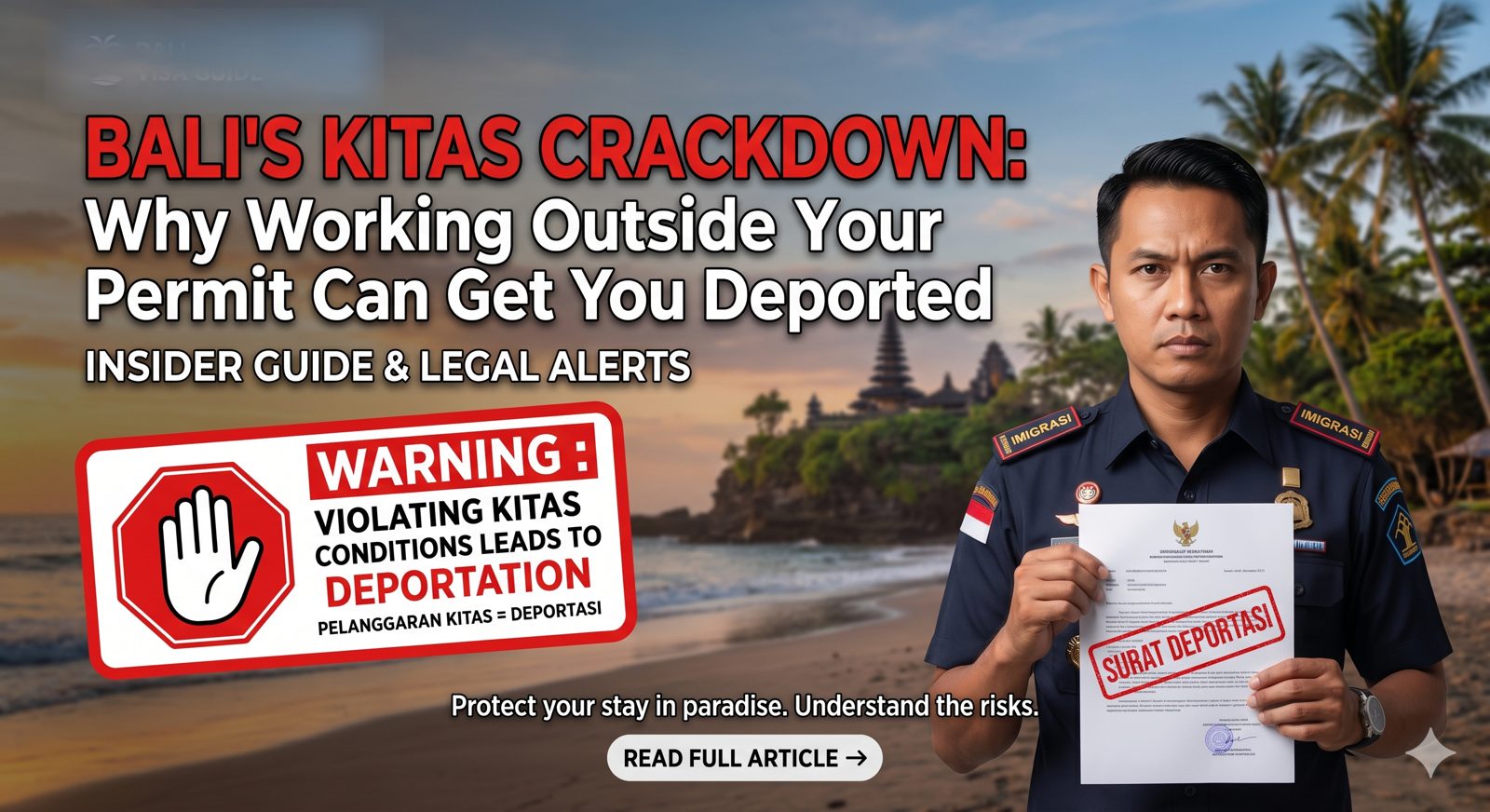
If you hold a Working KITAS in Bali and you have ever filmed a paid promo for a restaurant, modeled for a clothing brand, shot content for a villa that is not your employer, or quietly taken on a side gig — this is the article immigration wants you to read. In 2026, Indonesian immigration is no longer just checking whether you have a permit. It is checking whether the work you actually do matches the exact job your permit was issued for. Step outside that scope and you are not bending a rule — you are committing an immigration offence.
This is not a rumour circulating in expat Telegram groups. It is a documented enforcement shift, backed by national operations, dedicated task forces in Bali, and the active use of your own social media as evidence. Here is what your KITAS really permits, where the line sits, and what happens if you cross it.
What a Working KITAS Actually Authorises
A Working KITAS (the E23 limited-stay permit) is not a general licence to "work in Bali." It is permission to perform one specific job, for one specific sponsoring company. That job is defined long before your KITAS is printed, in a document called the RPTKA — the Foreign Worker Utilisation Plan (Rencana Penggunaan Tenaga Kerja Asing), approved by the Ministry of Manpower.
The RPTKA names your employer, your job title, your position's duration, and the salary band. Your KITAS is then issued against that plan. In immigration's eyes, your legal right to be in Indonesia is welded to that single role at that single company. A KITAS issued for a "Marketing Manager at PT Villa Co." does not authorise you to also be a freelance photographer, a yoga teacher on weekends, or a brand ambassador for a café down the road.
The core principle: Your permit is tied to a position, not to you as a person. The question immigration now asks is simple — "Is this foreigner doing the exact job their KITAS was approved for, and nothing else?" If the honest answer is no, the permit is being misused, regardless of how skilled, well-intentioned, or well-known you are.
The Law Behind the Crackdown: Article 122
The legal teeth come from Law No. 6 of 2011 on Immigration. Under Article 122, a foreigner who deliberately misuses — or engages in activities inconsistent with — the purpose of their stay permit faces imprisonment of up to five years and a fine of up to IDR 500 million (roughly USD 31,000). Critically, the same article also penalises any person or company that orders or enables that misuse — so the local business that hires you off-permit is exposed too.
In practice, criminal prosecution is the heavy end of the scale. The far more common outcome for individuals is administrative action: detention, deportation, and being placed on a re-entry blacklist that can bar you from Indonesia for six months, a year, or indefinitely. Either way, the life you built in Bali ends abruptly — flight at your own cost, contract void, lease stranded.
What Counts as "Working Outside Your Permit"
This is where most people get caught off guard, because the violation has nothing to do with whether cash changed hands. Indonesian immigration assesses work-like activity, and that net is wide. Based on recent enforcement, the following are treated as work that a position-specific KITAS does not cover:
- Promotional content & sponsored posts — reels, stories or videos promoting a hotel, restaurant, club or brand that is not your registered employer.
- Modeling & brand collaborations — photo or video shoots for clothing, beauty, wellness or lifestyle brands.
- Content creation as a service — filming, editing or producing media for third-party businesses.
- Side professions — teaching yoga, leading breathwork, tattooing, dive instruction, photography, DJ sets, personal training, or "consulting" outside your RPTKA role.
- Selling or reselling — acting as an informal villa agent, property reseller, or running a side business.
The trap is barter. Many creators tell themselves they are safe because "no one paid me." But immigration treats non-cash compensation as compensation. A free stay, a comped dinner, free products, or even exposure given in exchange for content is consideration — and the activity is still work. "I did it for free" is not a defence; in some cases it makes the activity look more like a commercial collaboration, not less.
Read this twice: The violation is the activity, not the payment. If you are performing a professional service that falls outside your registered KITAS position — paid, bartered, or "just for fun for a brand" — you are exposed. A tourist or social visa holder doing the same is in even deeper water.
Your Social Media Is Now the Evidence
The single biggest change in 2026 is how immigration finds violations. Officers no longer rely only on raids and tip-offs — they scroll. Public Instagram, TikTok and YouTube accounts are an open evidence file: a tagged hotel, a "paid partnership" label, a branded reel, a recurring class schedule, or a shoot location all build a picture of work that does not match your permit.
Indonesian authorities have publicly confirmed they monitor foreigners' social media activity as part of supervision. The irony is brutal: the very content people post to build a personal brand is what immigration uses to prove they are working off-permit. If your feed shows you doing a job your KITAS does not list, you have effectively filed a confession.
This Is Being Actively Enforced
The enforcement is real and organised. At the national level, immigration runs Operation Jagratara, a standing crackdown on permit abuse. In Bali specifically, dedicated units — reported under names such as the Bali Becik and Dharma Dewata task forces — coordinate field checks, villa inspections and follow-ups on social-media leads.
The numbers tell the story. Bali immigration has reported detaining dozens of foreigners in a matter of weeks for permit and activity violations, and a single multi-day national sweep in recent years processed hundreds of foreigners across hundreds of locations. The targets repeatedly named in these actions are exactly the people who think they fly under the radar: yoga and wellness instructors, photographers and videographers, tattoo artists, diving instructors, breathwork facilitators, and informal villa agents.
So What Is the Right Permit?
The good news: if your activity is legitimate, there is almost always a compliant route. The fix is matching the permit to what you actually do — not stretching a permit you already hold.
| If you want to… | The wrong move | The compliant route |
|---|---|---|
| Work a specific job for a company | Side gigs on a tourist visa | Working KITAS (E23) via RPTKA + the exact role |
| Take on extra roles/income streams | Doing them off your current KITAS | Update the RPTKA / add the activity, or a second sponsor |
| Create social-media content (short term) | Sponsored content on a tourist visa | C5A Content Creator Visa (with Indonesian sponsor) |
| Run your own villa / business | Nominee or informal operation | PT PMA company + Investor/Working KITAS |
The C5A Content Creator Visa
For genuine creators, Indonesia introduced the C5A Social Media Content Creator Visa. It allows social-media content activities, runs for 60 days and can be extended twice (up to 180 days total), and requires an Indonesian sponsor. Important caveat: it is a visit-category visa, not a work permit — it does not put you on a local payroll or let you take a registered job. It suits short-term creative projects, not building a business in Bali. For anything employment-based, you still need a Working KITAS aligned to your actual role.
The Fix for Off-Permit Work
If your reality has outgrown your permit, the answer is to formalise it, not hide it: amend the RPTKA to reflect new duties, add a second sponsorship where appropriate, or restructure through a PT PMA if you are effectively running your own operation. Indonesia made company setup dramatically cheaper in late 2025 — the kind of compliant structure that used to feel out of reach is now within range for many.
Not sure your setup is compliant?
InmoBali works with trusted legal, visa and notary partners. If you are living, working or building in Bali, get a free 30-minute call to pressure-test your KITAS, sponsorship and company structure before immigration does it for you.
💬 Book Free ConsultationThe Bottom Line for Anyone Living in Bali
Bali is not closing to foreigners — it is closing to improvisation. The era of holding one permit and quietly doing five things is over, and the enforcement infrastructure to prove it is now in place. The standard going forward is simple and unforgiving: do exactly what your permit says, and nothing else. If you do more, get the right permit for it first. The cost of compliance has rarely been lower; the cost of getting caught has rarely been higher.
This article is general information for foreigners living in Indonesia, not legal or immigration advice. Laws, visa categories, thresholds and enforcement practices change; figures and names of operations above are approximate and based on reporting current as of mid-2026. Always confirm your specific situation with a licensed Indonesian visa agent, lawyer or immigration consultant before acting.
Sources: Law No. 6 of 2011 on Immigration (Article 122); Ministry of Manpower RPTKA framework; Directorate General of Immigration (Operation Jagratara); Bali Regional Immigration enforcement reporting; Indonesian C5A Content Creator Visa provisions.