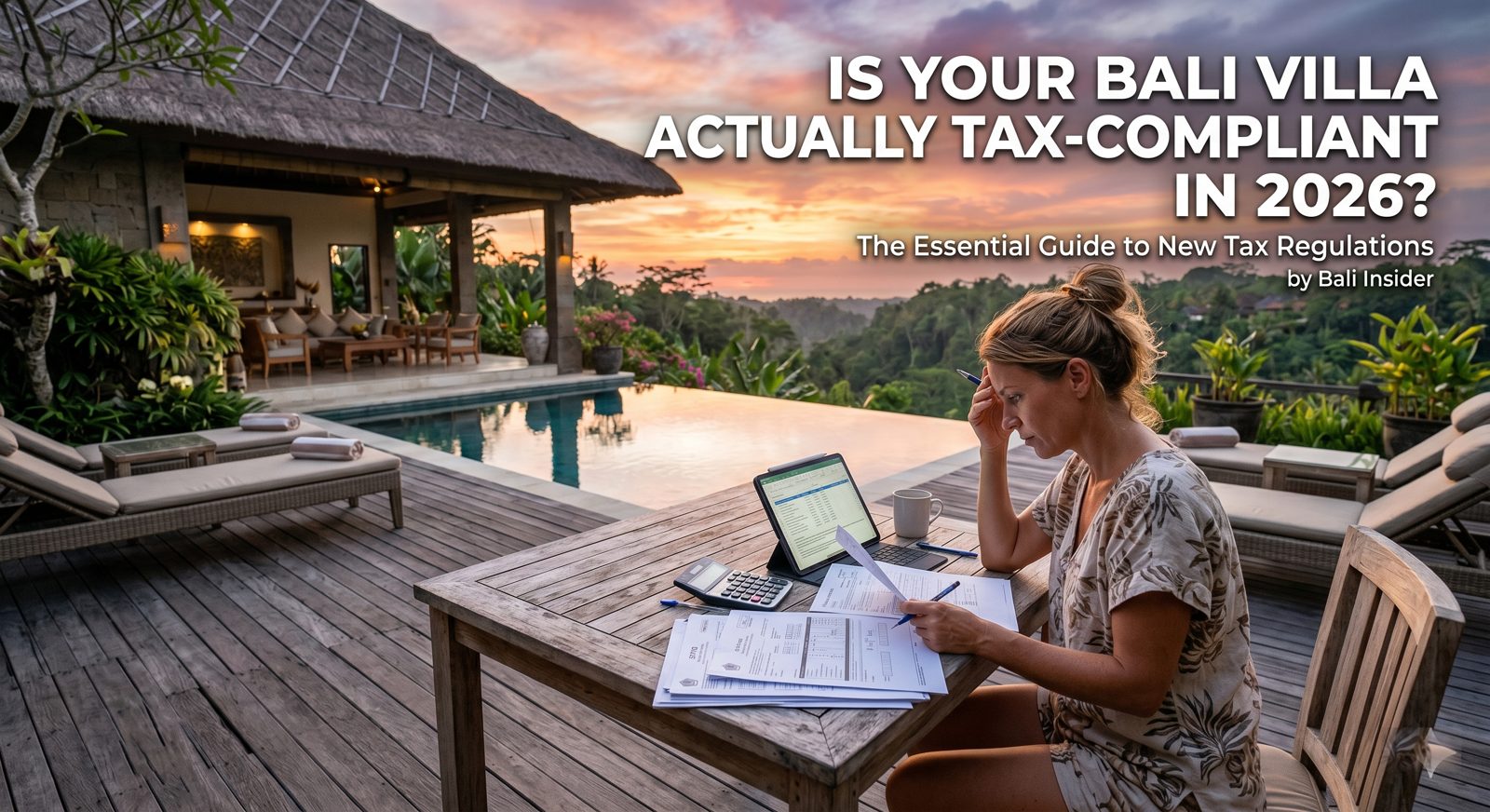
Ask most Bali villa owners how their rental income is taxed and you'll hear one number: "10%." It's true — but dangerously incomplete. In 2026, Indonesia's tax authorities are cross-referencing booking-platform data, bank flows and ownership records like never before, and the owners getting caught are not the ones who refused to pay — they're the ones who assumed a single flat 10% covered everything. Here's how villa rental tax in Bali actually works, where the 10% stops applying, and the structural red flags that trigger audits. This is general information, not tax advice — confirm your position with a licensed Indonesian tax consultant (konsultan pajak).
The 10% Foundation
The baseline is a final income tax (PPh) of 10% on income from renting out land and/or buildings in Indonesia. It applies to everyone — Indonesian citizens and foreign nationals, individuals and companies — across villas, houses, apartments, offices and commercial buildings. "Final" means it's a standalone tax on that rental income, not something later reconciled against a broader return.
The Catch: No Deductions
Here is the part owners consistently miss: the 10% is charged on your gross rental income — the full top-line — before any deductions. You cannot subtract operating costs, maintenance, management fees or agency commissions to shrink the taxable base. Crucially, even the slice an OTA platform (Airbnb, Booking.com) takes as commission is not deductible: tax is calculated on the price the guest paid, not on what landed in your account. Model your returns on gross, or you'll overestimate your net.
Who Actually Pays — the Responsibility Split
Who remits the 10% depends on your tenant:
- If the tenant is a company / PT: the corporate tenant generally must withhold the 10%, pay it to the government, and give you the tax evidence (bukti potong).
- If the tenant is an individual: the burden flips — the property owner is responsible for calculating, paying and reporting the tax.
Most short-stay villa guests are individuals, which means the duty to declare and pay usually sits with you, the owner — not the platform, not the guest.
The Airbnb Myth: Why 10% Might Not Be Enough
Assuming all villa income falls under the 10% passive rental tax is one of the most expensive mistakes in Bali. The moment your villa stops behaving like a passive lease and starts behaving like a business, the classification — and the tax — changes:
- Hosting daily guests and selling through OTA platforms,
- Providing services like housekeeping, reception or breakfast,
…all shift you toward an active hospitality operation. Passive final-tax rates were never designed to cover active commercial accommodation.
Rental vs Hospitality: Your Real Structure
The distinction the authorities care about is passive rental vs active hospitality:
| Factor | Standard rental (passive) | Hospitality (active) |
|---|---|---|
| Typical term | Yearly lease, fixed tenant | Daily / short stays |
| Services | None | Cleaning, marketing, guest service |
| Treated as | Passive land/building rental | An active hotel-type business |
| Core tax | ~10% final PPh on gross | Corporate income tax on profit |
| Local accommodation tax | Generally n/a | ~10% PB1 / PBJT on accommodation |
| Licensing | Minimal | Tourism / accommodation licensing |
Run a true short-stay operation and you can trigger local hotel tax (PB1, now under the PBJT regional-tax regime, commonly ~10% on accommodation), corporate taxes and tourism licensing — on top of, or instead of, the simple 10% final tax. Exact treatment depends on your structure and regency; verify with a licensed professional. For the wider picture of every property tax, see our Bali property-tax guide, and weigh the models in Airbnb vs long-term rental.
The Nominee & Banking Illusion
Operating through a local nominee's name does not shield a foreign investor from being traced. In 2026, authorities actively audit fund flows, beneficial ownership, management contracts and vendor payments. Two patterns are immediate red flags:
- Using a PT PMA company structure but receiving rental income into a personal bank account — a major violation.
- Outdated nominee setups and "split" banking lines that don't match the legal owner of record.
Your legal structure, your bank account and your tax filings need to tell one consistent story. (This is the same enforcement logic now closing many business types to new foreign companies and behind the push away from nominee ownership.)
The Cost of Bad Bookkeeping
Missing documents don't just risk a fine — they raise your bill directly. During a tax examination, a lack of proper documentation forces the authorities to fall back on estimated (deemed) assessments — and those government estimates are routinely much higher than your actual calculated liability. Clean, lean bookkeeping is your single best shield against an inflated assessment. Keep contracts, invoices, booking records and bank statements aligned and retrievable.
The compliant-villa checklist: (1) Know whether you're passive rental or active hospitality — it changes everything. (2) Budget the 10% on gross, OTA commission included. (3) Route income to the correct entity's bank account. (4) Drop nominee shortcuts. (5) Keep real books. Do these five and a Bali villa is a clean, high-yield asset; skip them and 2026's automated cross-checks will find the gap.
Is Your Villa Structure Actually Compliant?
InmoBali works with licensed tax and legal partners who structure villa ownership and rental operations the right way — passive or hospitality, leasehold or PT PMA. Tell us how your villa runs and we'll help you pressure-test the setup.
💬 Ask InmoBali