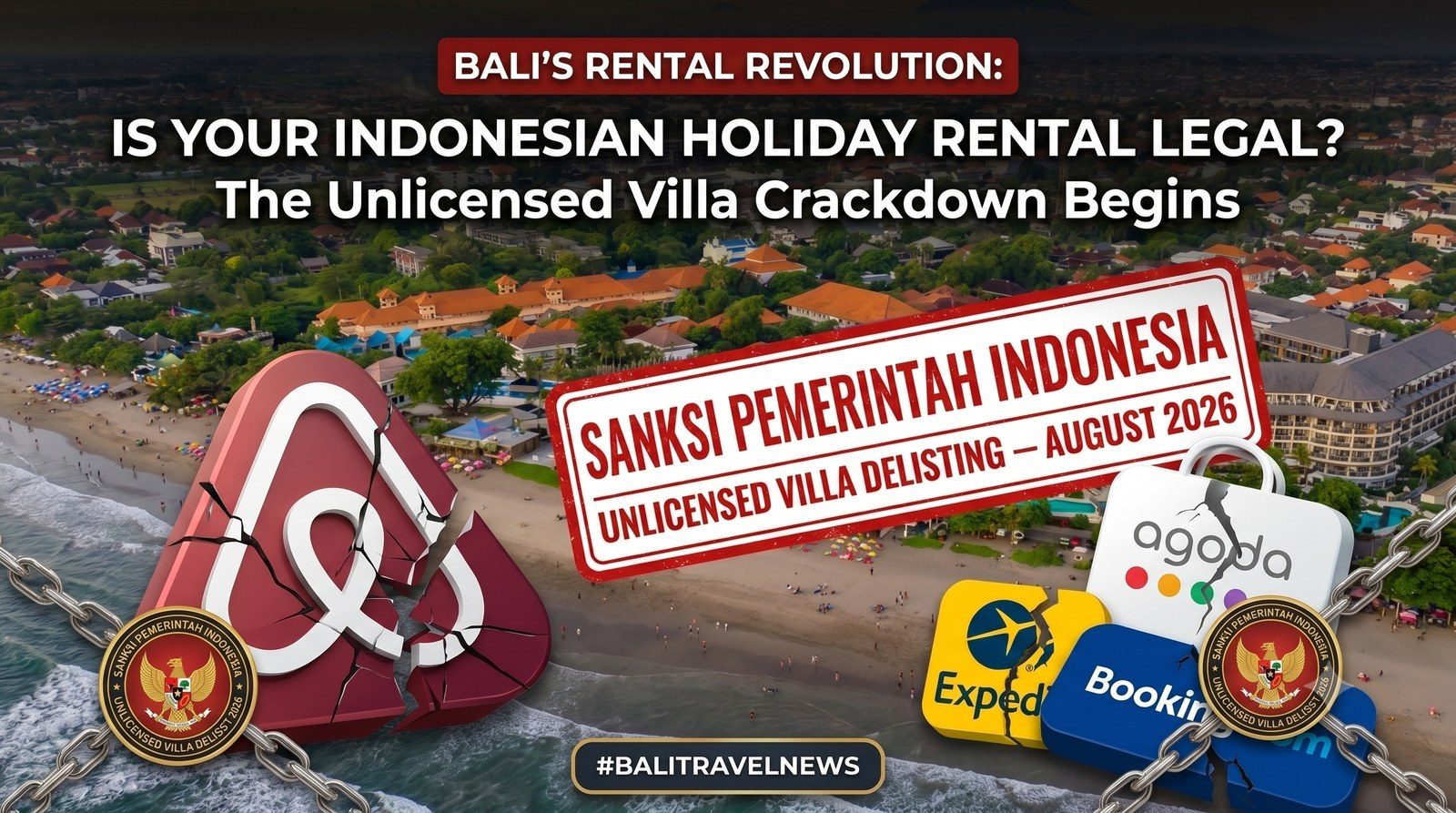
Indonesia's Ministry of Tourism is tightening the rules for short-term accommodation businesses listed on online travel agency (OTA) platforms — and Bali is squarely in the frame. Working with local authorities, industry associations and nine OTA partners, the government is moving from occasional manual checks toward an automated system that cross-references every listing against official business records.
The headline is simple. Around 1,600 accommodation businesses are still operating without proper licences while advertising on these platforms. Owners have been given roughly two months to complete their permits, and those who fail to comply may see their listings removed from 1 August 2026.
The one-line takeaway for any foreign villa owner: get your licensing in order before 1 August 2026, or risk being delisted from the very platforms your bookings depend on. The good news is that this is an organisation exercise, not a ban — and a compliant villa comes out of it stronger. This is general information, not legal advice — confirm your position with a licensed Indonesian professional.
What's Actually Changing
Until now, checking whether an accommodation provider held the right permits was largely a manual process. That is what's changing. The government is developing an integrated, API-based verification system linked directly to Indonesia's OSS (Online Single Submission) business-licensing database.
In practice, the platform automatically checks each OTA listing against government records. Where a listing can't be matched to a properly licensed business in OSS, it is flagged. The aim is that, in future, only licensed accommodations can be marketed online — verification happens by data, not by spot-checks. The full system is expected to be operational by June 2027, with the 1 August 2026 enforcement step being the bridge to it.
The Numbers and the Deadline
The facts owners need to plan around:
- ~1,600 accommodation businesses are still listed on OTAs without proper licences.
- Owners have roughly two months to complete their permits.
- Non-compliant listings may be removed starting 1 August 2026.
- Nine OTA platforms are partners in the initiative: Airbnb, Booking.com, Agoda, Tiket.com, Traveloka, Trip.com, Expedia, RedDoorz and OYO.
- Momentum is already visible: the number of short-term accommodation businesses registered with an Indonesian business number (NIB) in the OSS system rose roughly 47% (data to around May 2026) versus March 2025.
| What | Detail |
|---|---|
| Removal date | Listings may be removed from 1 August 2026 |
| Unlicensed count | ~1,600 businesses on OTAs |
| Time to comply | Roughly two months |
| OTA partners | Airbnb, Booking.com, Agoda, Tiket.com, Traveloka, Trip.com, Expedia, RedDoorz, OYO |
| NIB registrations | Up ~47% (to ~May 2026) vs March 2025 |
| Legal basis | Permenpar No. 6 of 2025 |
| Full system live | Expected by June 2027 |
The legal basis is Peraturan Menteri Pariwisata (Minister of Tourism Regulation) No. 6 of 2025. An earlier deadline of 31 March 2026 already pushed many operators to register; the 1 August 2026 enforcement is the next step in the same process.
Why the Government Is Doing This
The stated goal is a more organised and sustainable tourism industry — explicitly not to restrict or ban business. Over the past year the government has worked alongside local authorities, industry associations and the OTA platforms to help accommodation providers obtain the permits they need, rather than simply penalising those who lack them.
Three threads run through the policy:
- A level playing field. Operators who have done the legal work shouldn't be undercut by those who skipped it.
- Guest protection. Verified, licensed accommodation gives travellers a clearer standard to rely on.
- Long-term growth. Officials frame the initiative as strengthening industry standards and supporting the sustainable growth of Indonesia's tourism sector.
It's worth restating plainly: this is not a ban on Airbnb or short-stay rentals in Bali. It is a move to ensure the businesses on these platforms are properly registered.
What It Means If You Own or Rent a Villa in Bali
For an unlicensed villa, the risk is now concrete rather than theoretical. As the OSS-linked checks come online, a listing that can't be matched to a licensed business faces a real delisting risk on Airbnb, Booking.com, Agoda and the other partner platforms — and for most villa owners, those listings are the booking engine.
For a properly licensed villa, the same shift is an advantage. As enforcement tightens and unlicensed competitors come off the platforms, compliant operators keep their listings live, keep earning, and benefit from a cleaner, more credible market. Getting licensed isn't just defensive housekeeping — in 2026 it's a competitive position.
How to Get Compliant: the Checklist
To be compliant, a short-term rental generally needs the legal scaffolding below. The exact requirements depend on your property, location and regency, so treat this as a map rather than a substitute for professional advice:
- A registered legal entity. For foreigners, this typically means a PT PMA (foreign-owned company) — the standard vehicle for running an accommodation business legally.
- An NIB (Nomor Induk Berusaha / business identification number) in the OSS system — the registration the verification platform looks for.
- The correct tourism business licence under the relevant KBLI classification — for example the "pondok wisata" / villa accommodation categories that match how your property actually operates.
- Building and zoning fit. The property's permits and zoning should support tourist accommodation use.
- Tax registration. Licensing and tax go hand in hand; rental income carries its own obligations. See our companion guide, Bali villa rental tax compliance 2026, for how the income side works.
Processing time varies and is best confirmed case by case — but with a hard 1 August 2026 enforcement date approaching, the time to start is now, not in July.
How InmoBali Can Help
This is exactly the kind of work InmoBali handles day to day. We help foreign owners with the legal setup — including PT PMA formation, NIB registration and the right KBLI tourism licence — and we run full Airbnb and short-stay property management, so your listings stay compliant and keep earning rather than going dark on 1 August.
If you're not sure whether your villa is properly licensed, or you want a compliant structure built before the deadline, we'll give you a straight answer and a clear plan. No pressure, no jargon.
Is Your Listing Verified-Ready for 1 August?
InmoBali handles the legal setup, licensing and full short-stay management for foreign villa owners in Bali. Tell us how your villa runs and we'll check whether it will pass the new OSS-linked verification — and fix it if it won't.
💬 Ask InmoBaliYou can also reach our property-management team directly via InmoBali property management or email hello@inmobali.com.
FAQ
Is Airbnb banned in Bali?
No. The Ministry of Tourism has been clear that the goal is a more organised and sustainable industry, not a ban. Short-term rentals remain legal — they simply need to be properly licensed and registered to stay listed on OTA platforms.
What happens on 1 August 2026?
From that date, accommodation businesses that are still operating without proper licences may have their OTA listings removed. The cut-off is the enforcement step toward a fully automated, OSS-linked verification system expected to be operational by June 2027.
Can foreigners legally run a villa rental in Bali?
Yes — typically through a PT PMA company holding an NIB and the correct KBLI tourism licence. With the right structure in place, a foreign owner can operate a short-term rental legally and remain listed on the major platforms.
How long does licensing take?
It varies depending on the property, the documents already in place and the regency. Because timelines are confirmed case by case and the 1 August 2026 enforcement date is fixed, it's wise to begin as early as possible rather than leave it to the final weeks.
The bottom line: Indonesia is moving to automatically verify every OTA listing against the OSS licensing database. Around 1,600 unlicensed accommodations risk removal from 1 August 2026, with the full system due by June 2027. This is organisation, not prohibition — get a PT PMA, an NIB and the right tourism licence in place, and your villa stays compliant, listed and earning.